
Remembering Bishop Christopher Ssenyonjo: A Bishop Who Chose Love

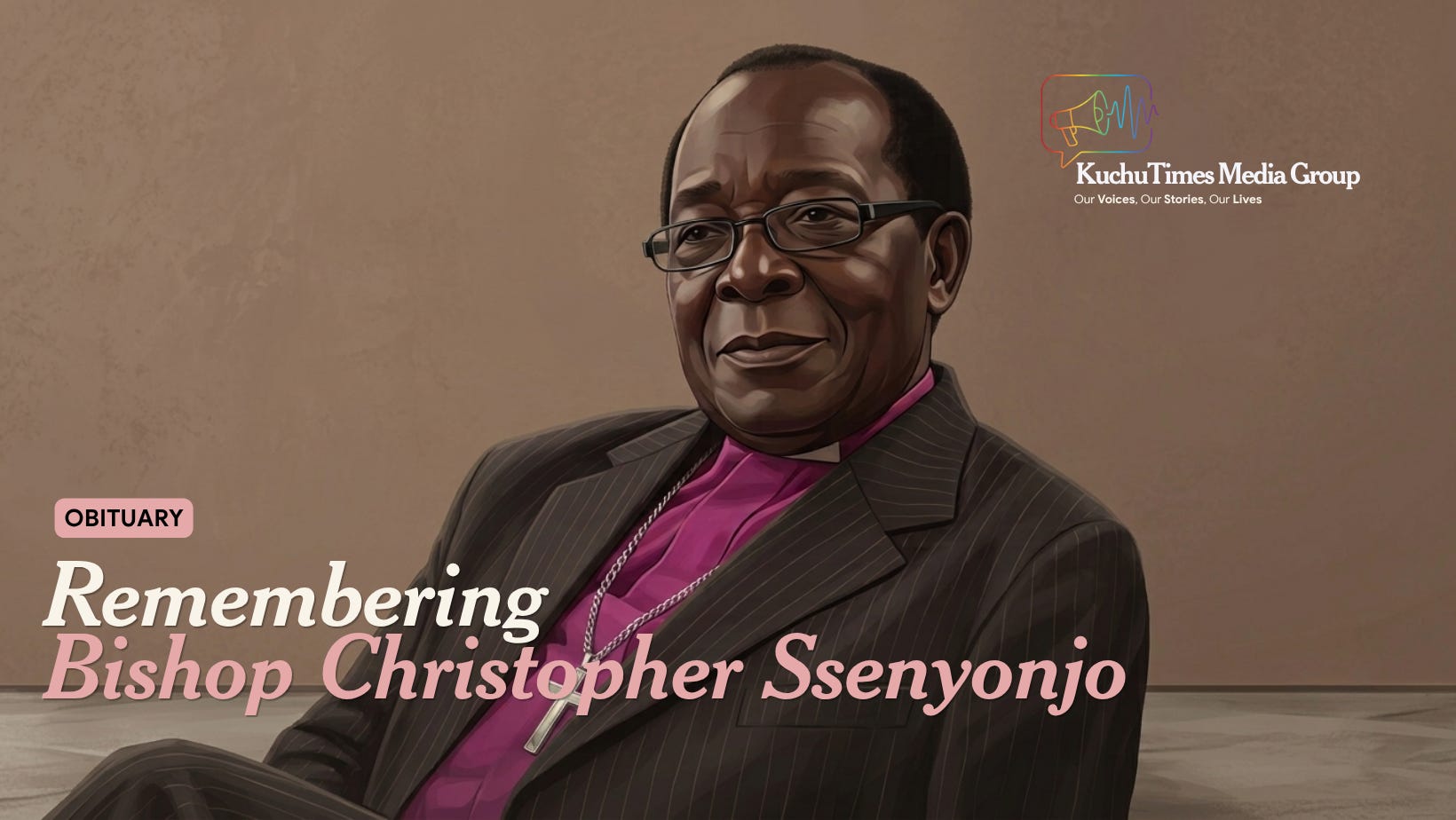
Bishop Christopher Ssenyonjo has passed away at 94, after a hospitalization of over two months. For Uganda’s LGBTQ+ community, this is a heavy loss. He was not one of us. But for decades, he stood beside us, and in doing so, he showed many queer Ugandans something rare: what it could look like to be Christian and to love without condition.
An ordinary path, at first
There was nothing in Ssenyonjo’s early life that suggested where he would end up. He trained as a teacher after a failed attempt at medical school, and it was the death of his first wife, shortly after their marriage, that led him toward ordination. From there, his career in the Church of Uganda followed a fairly conventional path. He was made bishop of the Diocese of West Buganda in 1974 and served until his retirement in 1998.
By the time he retired, he could have simply stepped back. Instead, that is when his real work began.
Listening, without condemning
After retirement, Ssenyonjo opened a small counseling practice on the outskirts of Kampala. His office had a dusty desk, a used couch, and often no electricity. It was here that gay Ugandans, with nowhere else to go, began quietly seeking him out.
He described his approach simply: “The attitude of my church is that I should condemn them. But I refuse.”
That refusal mattered more than it might seem. Many queer Ugandans grow up hearing that their faith and their identity cannot coexist, that God rejects them unless they change. Ssenyonjo showed, through his own life and ministry, that this was not true. He counselled a young gay man who had been contemplating suicide after being told God did not love him as he was. Ssenyonjo told him to accept himself, that God loved him as he was. The young man’s mother later came to accept her son too, and he says she died at peace, knowing him fully.
For many in the community, this was the first time they had heard someone with real standing in the Church say, plainly, that they belonged.
The cost of that choice
His stance came at a price. In 2001, he was barred from performing services, officially over his role in consecrating a bishop from a church not in communion with the Church of Uganda, though it is widely understood that his support for gay rights was the real reason. By 2006, the Church of Uganda declared he was “no longer a bishop” and revoked his remaining privileges over his continued ties to LGBTQ-affirming denominations.
He was also exposed publicly for it. A local tabloid once listed him among the country’s “top 200 homosexuals,” despite his own wife and six children, simply because of who he stood with. In a country where such lists have led to real danger for the people named, this was not a small risk.
Rather than step back, he built something lasting. He founded Integrity Uganda and the St. Paul’s Reconciliation and Equality Centre in Kampala, places built for people the Church had turned away. In 2000, he took in two LGBT youths who had been rejected by their own families, schools, and communities. This was not an isolated act. It was the pattern of his later life.
Speaking up when it counted
Ssenyonjo did not go quiet as Uganda’s laws grew harsher. When politicians passed a law in 2014 allowing for life imprisonment under charges of “aggravated homosexuality,” he was one of the few religious figures willing to say publicly that the law was wrong. He explained his reasoning in plain terms: prejudice, he said, comes from ignorance and misinformation, not truth.
His work reached beyond Uganda. He received the Clinton Global Citizen Award at the Clinton Global Initiative’s Annual Meeting for his advocacy, and spoke at institutions abroad, including the Harvard Kennedy School. In 2016, when the community gathered to remember David Kato, Ssenyonjo was there among them.
No regrets
Late in his life, he was asked to reflect on it all. At 92, he said he had no regrets. His children had struggled to understand his work at first, but came to respect it. He put his life’s purpose simply: “I am doing something which I believe God has told me to do: love all people. All people are God’s children; none is left out. I have faced problems, but that is part of God’s plan, and I am really satisfied.”
What he leaves behind
Bishop Ssenyonjo was not gay. He did not have to take on this fight. But for many queer Ugandans, especially those raised in the Church, he offered something they had rarely seen: a Christian who chose love over condemnation, and who kept choosing it even after it cost him his title and his safety.
He showed that faith and acceptance were not opposites. For a community so often told otherwise, that example mattered, and it will keep mattering.
Rest well, Bishop. Thank you for showing us what it looks like to believe, and to love, without exception.
If you’d like to share a personal message or reflection for Bishop Ssenyonjo, you can do so here: https://padlet.com/admsmug/in-loving-memory-of-bishop-ssenyonjo-b4wi8xxkotn9xbb5
KuchuTimes Media Group extends its condolences to Bishop Ssenyonjo’s family, friends, and all those whose lives he touched.